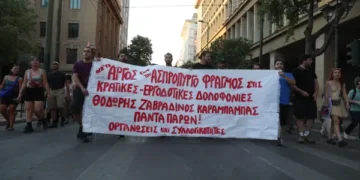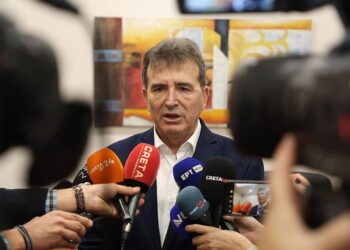

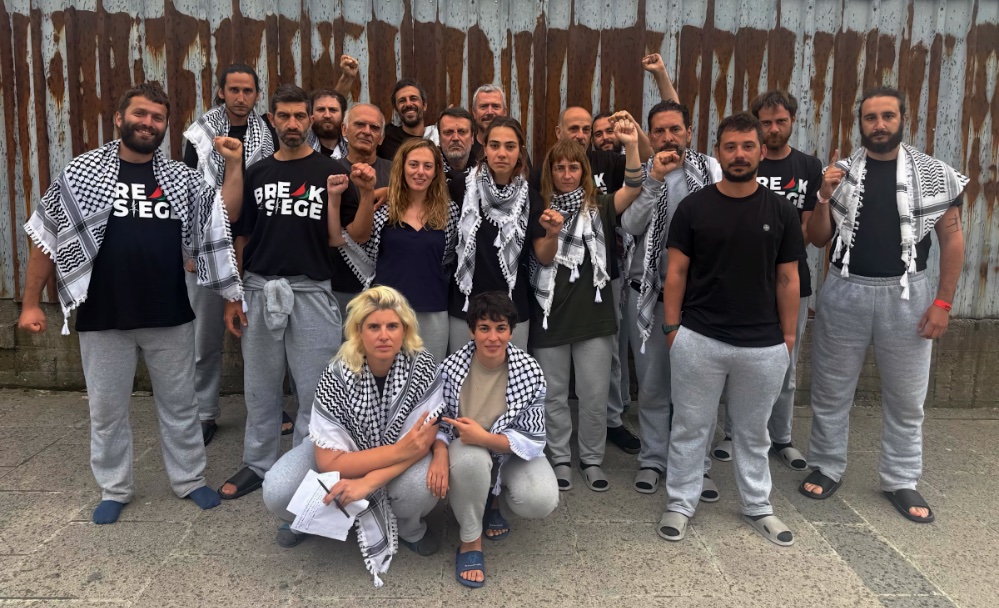
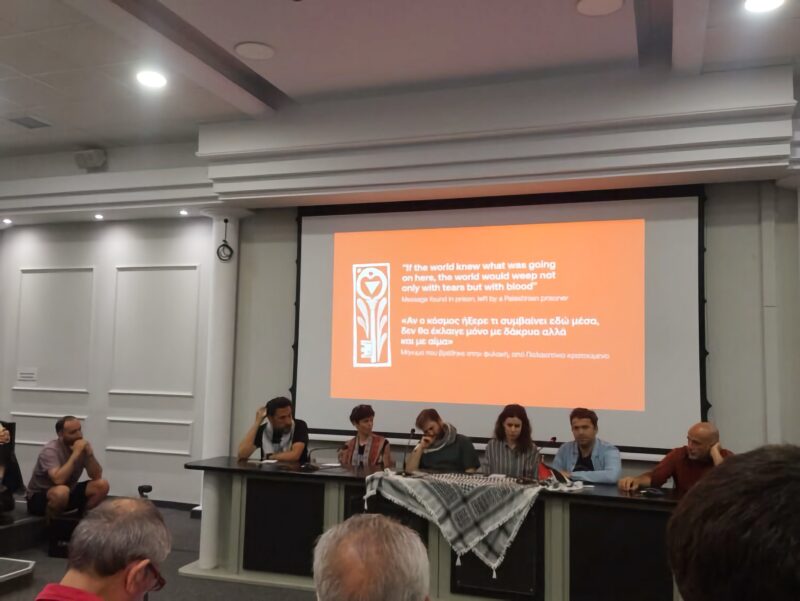
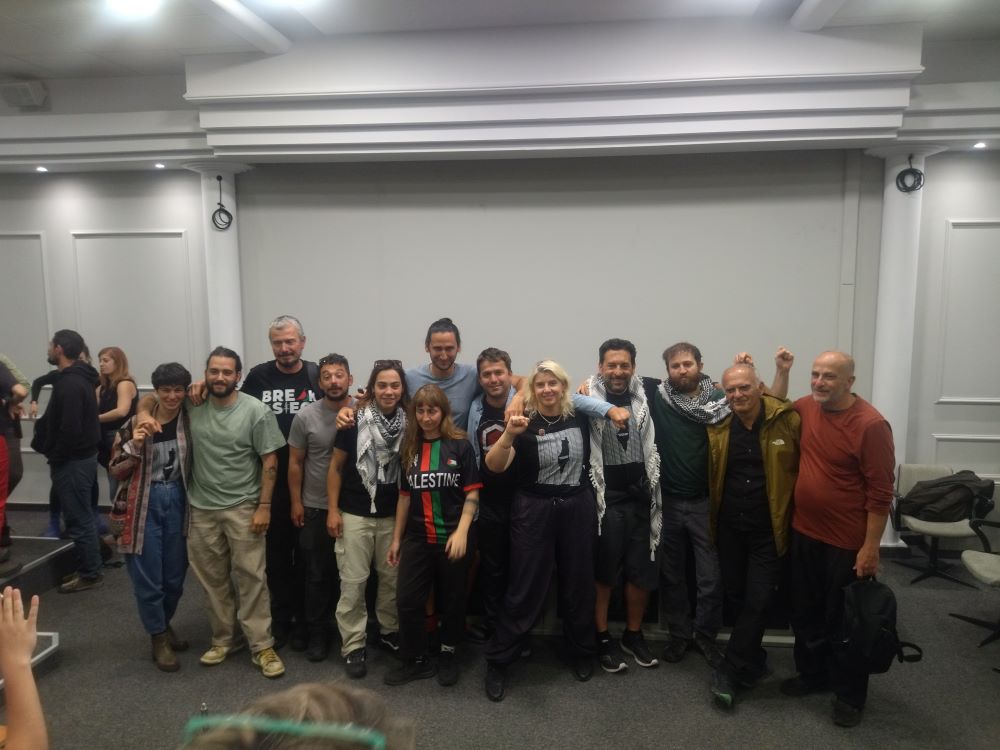
Members of the Greek delegation described the horrific moments they experienced following the interception of the Global Sumud Flotilla during a press conference held at noon on Saturday after their return to Greece. The activists spoke about the conditions of detention, violence, humiliation, torture, as well as sexual harassment and verbal abuse they suffered at the hands of the Israeli authorities. They also reflected on the political conclusions arising from the stance of the Greek and Cypriot governments.
At the same time, they stressed from the outset that what the delegation members went through was nothing compared to what the Palestinian people have endured for decades: continuous oppression and arbitrariness, the denial of all kinds of rights under a regime of apartheid, occupation, and ethnic cleansing, culminating in genocide in recent years.
At the beginning of the press conference, it was announced that three members of the delegation could not attend because they were hospitalized, while further legal action was also foreshadowed following the examination of crew members at Attikon Hospital and the upcoming referral to forensic services.
“The mission would have succeeded — we would have reached Gaza”
Anna Lagonikou, who was noted to be participating in a mission to Gaza for the second time, stated that the violence faced by the crews this time bore no resemblance to previous missions. She spoke of serious injuries, broken ribs, and fractured vertebrae, emphasizing that what occurred represented a new escalation.
She argued that the mission would have managed to reach Gaza had the Greek and Cypriot governments not cooperated with Israel to prevent it. She linked these events to previous Israeli attacks on vessels south of Crete and to actions taken within Greek and Cypriot zones of responsibility. According to her, this cooperation concerns not only this particular mission but the broader ability for the genocide to continue with the support of Western governments.
She also stressed that the activists found themselves inside a floating torture unit, confronted with a new mechanism of abuse designed for those standing in solidarity with Palestine. She emphasized that the know-how behind this mechanism had been developed through the long-term oppression of Palestinians and warned that if no reaction follows, Israel’s impunity will allow such practices to expand beyond the borders of Palestine.
“It was a very well-organized state plan”
Vangelis Theodoratos emphasized that what happened to the activists’ bodies was neither accidental nor the result of a few soldiers acting arbitrarily. He described it as a carefully organized, state-structured plan with specific stages, orders, and procedures. According to his testimony, entry into the prison ship followed an almost standardized sequence: detainees were thrown to the ground, beaten, tasered, and humiliated, passed through checkpoints, and were then led into containers regardless of nationality, gender, or age.
On the political dimension, he stressed that the mission was not an isolated incident but part of the struggle for the freedom of Palestine and for freedom everywhere. He underlined that states are not going to stop what is happening and that the responsibility lies with societies and free people. He thanked those who mobilized in Greece, saying that public pressure in the streets and solidarity played a decisive role in the fate of the crews.
“The sea was transformed into a floating prison”
Antonis Vradis focused on the conditions aboard the “floating prison,” emphasizing the need to expose a torture mechanism tested on the activists’ bodies. He described the container where dozens of people were held for around 50 hours or more, with minimal food, insufficient water supply, and nearly nonexistent hygiene conditions. According to him, bread was the only food provided, and in inadequate quantities, while the absence of toilet paper and the existence of only two chemical toilets for around 170 people reflected the degrading nature of the detention.
He also described how even water distribution was carried out in a violent and intimidating manner: soldiers emerged from containers in formation, used stun grenades, fired rubber bullets, and only then left a small amount of water for dozens of people — specifically 24 bottles for 170 individuals.
He referred to the sleeping conditions as well, where detainees were piled on top of one another, while those near the openings of the containers had lights and weapon lasers pointed at them throughout the night.
He also spoke about being forced to kneel for hours as one of the worst forms of torture he endured. He said that after only a few minutes he could no longer manage the pain and that what kept him going was the thought that, in the same place and the same position, thousands of Palestinians — parents and children alike — had stood before him. For him, the darkest aspect was that the sea, which he associated with freedom, had been turned into a place of detention.
“A Fordist production line of torture”
Pantelis Vlachas spoke of a “Fordist production line of torture,” arguing that these were not isolated incidents or reactions against certain activists who protested. As he explained, the Israeli authorities had implemented an organized procedure aimed not only at the body but primarily at the dehumanization of detainees.
He described people being forced to keep looking down constantly without raising their heads, in a process designed, as he said, to make them feel they were not being treated as human beings. He spoke of successive stages of control, humiliation, and violence: first detainees were asked about medical conditions or medications, creating the illusion of basic care, and immediately afterward they were taken into containers where they were beaten, tasered, threatened, and held at gunpoint until they fell to the ground.
Detainees passed through this process one by one, like on an assembly line, while the others listened to their comrades being tortured without being able to intervene. He stressed that everyone felt they could break — not only because of the physical suffering but above all because of the attempt to strip them of their humanity. What sustained them, he said, was looking at one another, recognizing the same ordeal in each other’s eyes, and drawing strength from comradeship and solidarity.
“We hold onto the gaze of our comrades”
Kostas Kalaremas participated in the Freedom Flotilla Coalition mission, whose members were detained alongside those of the Global Sumud Flotilla under similar conditions. He spoke of a floating Guantánamo where solidarity flourished.
“As I was inside the containers, Primo Levi’s book If This Is a Man came to mind, and I thought that some people had learned the wrong lesson.”
He recounted that they came under fire when the Israeli navy attempted to seize their vessel, that they were tortured with tasers in order to reveal who the captain was, and that a woman who claimed to be the captain was shot in the leg. He spoke of beatings but emphasized that none of the crew members gave in.
“We hold onto the gaze of our comrades and their smiles.”
“This escalation demands escalation from us”
Giannis Pantazopoulos focused on the psychological dimension of the torture. He described a process aimed at crushing personality, where detainees were treated as bodies without will, while authorities formally recorded their illnesses and medications without any intention of actually providing them — a practice functioning as a form of humiliation and weakening.
Politically, he argued that Israel’s stance toward solidarity missions has escalated compared to previous attempts. This escalation, he said, requires a corresponding response from the movement, through strengthening actions, collaborations, and goals. He referred to the need to strengthen BDS and to elevate the Palestinian issue into a central political issue in Europe.
He also made clear that a European passport is essentially useless, since no European country defended its citizens. He directed particularly harsh criticism at the Greek government, which he described as completely subordinated to the United States and Israel.
“The people will protect the people”
Phaedra Vokali placed particular emphasis on the stance of the Greek government after the activists’ return. As she explained, when they arrived in Istanbul, neither an ambassador nor a consul was there to meet them, but merely an employee who informed them that there was a bus to Thessaloniki waiting — something she viewed as a sign of contempt and vindictiveness.
Regarding the treatment of detainees, she spoke about both the systematic nature of the process and the randomness of the violence. Despite prior preparation regarding which individuals might be considered more vulnerable, it became clear that everyone aligned with the demand for Palestinian freedom was a potential target. It did not matter whether someone was white or non-white, male or female, more or less vulnerable — violence could be directed at anyone at any moment.
She also referred to the case of a young German detainee suffering epileptic seizures who was asking for her medication. When she protested more forcefully, she was taken to an adjacent area where her finger was broken. According to Vokali, no state or authority protected them from Israeli torture, and therefore it became clear that only the people can protect the people.
“I did not encounter a trace of humanity”
Vicky Kotsori spoke of her inability to fully process physically and psychologically what she had experienced. She said her survival mechanism was to strip away anything that reminded her of humanity and to detach herself from her emotions. She described her return as the return of a body — but not an unharmed one — noting that the activists will continue speaking for a long time and that no terror will silence them.
In a later intervention, she stressed that unlike Palestinians, the activists at least now have the privilege of being in relative safety, where they can gradually express and heal their physical and psychological wounds. Palestinians, she said, either return to a devastated Gaza or remain inside the hellish detention system of the Israeli authorities, with no possibility of healing.
Responding to a question about whether she encountered any humane behavior, she said she did not witness even the slightest trace of humanity at any point during her detention. She acknowledged only fleeting differences in places where police officers or employees were present, describing one incident in which a young officer slightly loosened a detainee’s restraints and, once noticed by colleagues, began striking detainees on the head.
“No wave back”
Iasonas Gousetis-Gkinis stressed that every notion of international law — including maritime law — is dead, and that when we ignore something because it seems far away, it eventually reaches us too.
“No one is safe,” he said, arguing that the response lies within the movement itself, with the principle: “Not one step back — no wave back.”
Giannis Atmatzidis said that after 50 years at sea, this was clearly the most difficult mission of his life.
“I could never have imagined that human beings could torture other human beings,” he said, comparing the prison ship in which they were held to slave ships.
“The people in the mission were extraordinary, especially the young ones. They gave me courage and hope. I thank everyone who took part in the effort.”
“A complete hell was sailing freely across the Mediterranean for days”
A short message from Giorgos Tsiris, who was hospitalized and unable to attend, was read aloud. In it, he described the three days they endured as an experience reminiscent of Dante and the inscription at the gates of hell: “Abandon all hope, ye who enter here.”
In his message, he stated that a complete hell had been sailing freely across the Mediterranean for days, torturing people with the complicity of governments. Yet he stressed that what the activists experienced is nothing compared to what the Palestinian people have suffered for decades, emphasizing that the struggle for a free Palestine will not stop.
“Our country must stand on the right side of history”
Elsewhere in the press conference, members of the mission also highlighted the solidarity shown throughout the preparation and journey. It was mentioned that the mission began months earlier with a small core of people and that as needs increased, so too did the number of people volunteering to help.
Special mention was made of the people in Crete who mobilized after the first Israeli raid, of the legal support, transportation to hospitals, accommodation, and care for the crews, as well as the solidarity shown in Syros, Rhodes, Kastellorizo, and every place where a need emerged and someone immediately stepped forward to help.
In the same context, it was emphasized that the country must stand “on the right side of history,” alongside international and maritime law, which they argued had been violated. Attention was also drawn to the next humanitarian mission to Gaza, currently in Libya, with a call for it to receive as much visibility as possible.
“They must assume their responsibilities”
The legal team pointed out that the possibilities for legal action against Israel are limited because, as stated, Israel has signed very few conventions and has not accepted mechanisms allowing individual complaints for violations. Nevertheless, they stressed that there remains room for legal action against states such as Greece and Cyprus, which have obligations under international and European law.
In this context, reference was made to interim measures previously submitted to the European Court of Human Rights regarding an earlier incident, requesting that two individuals not be transferred to Israel. According to the legal team, although those individuals were eventually transferred and later returned to their countries, the Court did not immediately reject the request but instead submitted questions to the Greek government, indicating that it had identified the issue of the informal abduction of individuals from the territorial waters of a European country.
The legal team emphasized that Greek and Cypriot authorities had been informed and called upon to ensure the safe passage of the vessels and their crews. It stated that the interceptions, abductions, psychological violence, surveillance of lawyers, and detention conditions form a recurring pattern of human rights violations. It called for independent and impartial investigations to clarify what happened aboard the ship, during the journey, and on Israeli territory, stressing that governments must now assume their responsibilities.