
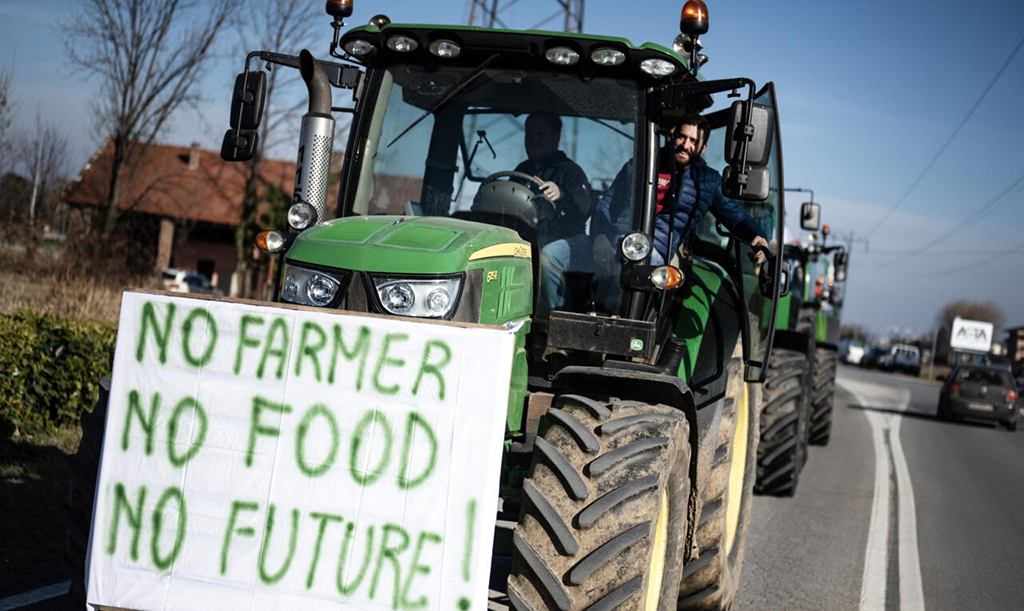
The struggle of European farmers is not corporatist, and food is not a commodity—it is a fundamental condition for the survival of the people. Therefore, this is a deeply social struggle that concerns the entire working class. Farmers in the EU themselves have understood that this is an existential struggle: a struggle over whether they will continue to exist as a social and productive subject or whether, ultimately, they will disappear.
The Common Agricultural Policy (CAP), trade agreements such as EU-Mercosur, and the institutionalization of new Genetically Modified Organisms (new GMOs) constitute a single, unified policy. Control over food, which is already in the hands of a few multinational, multi-sector monopolies, is deepening and being technologically upgraded, while at the same time environmental conditions, food quality, and the independence and autonomy of each country over its own food are being degraded. Agricultural struggles share a common root cause in all of the above. They are not limited to one country. Especially in recent years, there has been a continuous wave of mobilizations, with different forms but a common foundation: opposition to the aggressive capitalist restructuring of agricultural production.
The EU’s Common Agricultural Policy has been in force since 1961. It has always functioned in favor of agribusiness multinationals, industrialists, and capitalist large landowners, and against the working class and the poor of both countryside and city. According to Eurostat, in the 15-year period 2005–2020, the implementation of the CAP eliminated five million poor farmers (a reduction from 15 to 10 million). During the same period, 200,000 poor farmers were eliminated in Greece. According to a recent study by the European Parliament’s Committee on Agriculture on the future of European agriculture, by 2040 a further reduction of EU farmers by 62% is expected—from 10 million to 3.9 million—along with further concentration of agricultural land into farms larger than 500 stremmas.
A tiny minority of wealthy landowners and industrial producers absorb the lion’s share of EU subsidies originating from the CAP. Industrial-scale farms in the EU account for 8% of the total, yet absorb 37% of direct CAP subsidies and 70% of loans. In contrast, small farms, which make up 67% of the total, receive only 25% of subsidies and 5% of loans. Some of the wealthiest people in Europe receive enormous sums from the CAP, particularly in six EU countries: the Czech Republic, Denmark, Germany, Italy, the Netherlands, and Spain. In these countries, the top 10% receive on average two-thirds of subsidies, while the top 20% receive around 80%. The Netherlands presents the most extreme disparity, with just 1% of beneficiaries receiving 40% of CAP funds. Revealing is the example of the AGROFERT group of Czech Prime Minister Andrej Babiš, which received €16.6 million in 2024. Large sums were also received by Italy’s largest landowner, Bonifiche Ferraresi. In Greece, while medium to large farms make up only 12% of the total, they receive 34% of direct aid. Although Greece has fewer industrial-scale farms (with economic output above €250,000), their number has clearly increased (+59%), from 540 to 860. In 2007, there were only 40 industrial-scale farms with annual output above €500,000. By 2021, there were already 300.
At the same time, farmers took to the streets en masse over the EU-Mercosur agreement and the enormous imbalances it will bring about. As is well known, this agreement favors the mass import of cheap agricultural products from Latin America, produced through extensive and intensive cultivation using pesticides and farming practices banned in the EU. The EU seeks to import cheap, mass-produced staple crops in order to reduce production costs in industrialized domestic food supply chains and enhance the competitiveness of European capital. On the other hand, it aims to export agricultural technology and high value-added reproductive material to Latin America, maximizing the profits of European agrifood monopolies. This is strategically linked to the promotion of new GMOs.
The European Commission has paved the way for deregulating the existing—already weak—framework for labeling and traceability. Companies that own gene-editing technologies are pushing for full liberalization so that new GMOs can enter production en masse without mandatory labeling and traceability. It should be noted that new GMOs represent the spearhead of European multinational agrifood capital, through which it seeks to negotiate new markets in opposition to the dominance of U.S. multinationals in Latin America.
The EU–Mercosur agreement has a broader geopolitical dimension, which explains the haste of Commission President Ursula von der Leyen to sign it even before the final vote in the European Parliament. The political component of the agreement provides for summits, councils of ministers, and high-level officials. Political cooperation will cover foreign policy, multilateral diplomacy and international organizations, security and regional stability, human rights, and mechanisms of political consultation. It is therefore clear that the agreement opens the way for forming an alliance between the European Union and the states of South America, at a time when the U.S. is distancing itself from the EU, EU–Russia relations are at their lowest point, and EU–China relations are in a difficult phase. From this perspective, the EU–Mercosur agreement is of strategic importance for EU capitalists.
The agreement will boost Greek exports of transport services—that is, the profits of Greek shipowners—since they will take a large share of the transport work generated by the expansion of trade relations between the EU and Mercosur. It should be noted that in Greece shipowners pay €0.50 per liter for fuel, while farmers pay €1.70 per liter. The Spanish center-left government views the agreement in the same spirit. Spain’s agrifood industry expects to find new markets for olive oil, wine, table olives, and a range of other emblematic products. The stance of Prime Minister Pedro Sánchez’s government largely explains why the Socialist group in the European Parliament supports the agreement. The enormous pro-EU political consensus of bourgeois and petty-bourgeois parties, and the tragic absence of an anti-EU Left, are leading to the dangerous, pan-European political rise of far-right, fascist “Euroscepticism,” which exploits and neutralizes popular anti-EU sentiment while wearing the mask of a fake “anti-systemic” posture.
The agreement will accelerate the violent restructuring of the weakest sectors of agricultural production, meaning the destruction of smaller farmers. Alongside industrial products and services, the EU wants to sell expensive food and beverages (theoretically high-quality) to meet the dietary needs of the upper and middle classes in Europe and Latin America. As for the diet of workers and popular strata in the EU, it will be covered by imports of genetically modified and degraded products from third countries—mainly those with which the EU has signed or plans to sign preferential trade agreements, such as India, Turkey, Morocco, Tunisia, Mercosur, and others. The agreement will have very serious environmental consequences due to further deforestation (in the Amazon and elsewhere), which will be converted into farms. Equally serious environmental impacts will occur in EU member states.
The pan-European farmers’ uprising has brought the contemporary food–agricultural question to the forefront of political confrontation. This consists of the global explosion of the contradiction between food overproduction on the one hand and hunger and poor, adulterated nutrition on the other. Global food production today is more than double global nutritional needs. At the same time, 11 people die from hunger every minute, or 16,000 per day—mainly children.
Meanwhile, successive “health crises” break out (such as this year’s sheep pox in Greece), which have their roots in the model of intensive, industrial livestock farming that is extremely vulnerable and fully dependent on pharmaceutical and technological monopolies.
Under these critical conditions, the survival of the rural poor requires and presupposes:
-A common front of struggle among poor farmers, land workers, the working class, students, and youth
-Abolition of the CAP and the overall overthrow of the anti-popular policy of governments–EU–capital
-An anti-capitalist, internationalist exit from the EU with a communist perspective
A radical solution to the contemporary food–agricultural question can only be revolutionary. As long as food production remains in the clutches of capital, social control, dependency, impoverishment, and ecological destruction will intensify. The common struggle of farmers and workers is a struggle to regain control over life itself: what is produced, how it is produced, and for whom. Because without farmers, without land, and without social control over food, there can be neither food security nor freedom.