
Panagiotis Xoplidis
If we believe Donald Trump, a communist has been elected mayor of New York, the world capital of capitalism. The truth is that Zohran Mamdani, as a Muslim immigrant, represents everything that the fascist rhetoric of the president of the United States targets. However, he is a moderate social democrat, a member of the DSA (Democratic Socialists of America), with the central goal of his campaign to make New York “more affordable for the many”, through rent freezes and controls, free and fast buses, kindergartens and municipal grocery stores.
None of this would have been considered radical a few decades ago, and certainly none of it has anything to do with communism. Even in the United States, which never had a centralized welfare state, there was a strong tradition of social democratic policies in municipalities that had implemented large public infrastructure projects in the past. What makes Mamdani’s program seem “extreme” is the brutality of modern capitalism and its extent in the United States. Similar measures, after all, are maintained in many cities in the capitalist world, even in much poorer countries.
style=”font-size: large;”>What does Zohrab Mamdani’s triumph mean in the world capital of capitalism
The political earthquake is therefore not about the program – which is important and necessary for the working class – but about the fact of its clash not only with Trumpism, but also with the crisis of American capitalism. New York has not been left unscathed. Daily life is unlivable in neighborhoods where the one million of Mamdani’s voters live and the 100,000 who mobilized as an electoral mechanism, bringing politics back to the streets. Although the election campaign has taken on a national dimension, Mamdani has emphasized his status as a New Yorker (in a city where nearly 40% of the population is foreign-born), focusing on local problems with a moral discourse protective of a secular, multiracial democracy.
Solving the most acute problems is extremely precarious, since even small improvements will depend on the “realism” of the municipal budget. The mayor’s authority to intervene in rent prices is limited, and already, in an interview with the New York Times, Mamdani has stated that he has changed his mind about the role of the private sector in housing construction. The proposed housing cooperatives will be collectively managed, but will operate within the market, without relying on government subsidies.
The four-year rent freeze will affect a small percentage of apartments, as increases or decreases are made based on a specific formula defined by law, without the possibility of major intervention. Mamdani’s pragmatism is already underlined by the staff that will support the municipal government. Among other things, he will ask Jessica Tisch, current commissioner of the New York Police Department, to remain in her position. Tisch is the scion of one of the city’s wealthiest families and a member of the Anti Defamation League, a Zionist organization responsible for the persecution of many activists of the Gaza solidarity movement on charges of anti-Semitism. His inner circle also includes Patrick Gaspard, former president of George Soros’ Open Society Foundations and the think tank Center for American Progress, which is at the heart of the Democratic Party establishment.
Political polarization is growing and will not be easy to integrate.
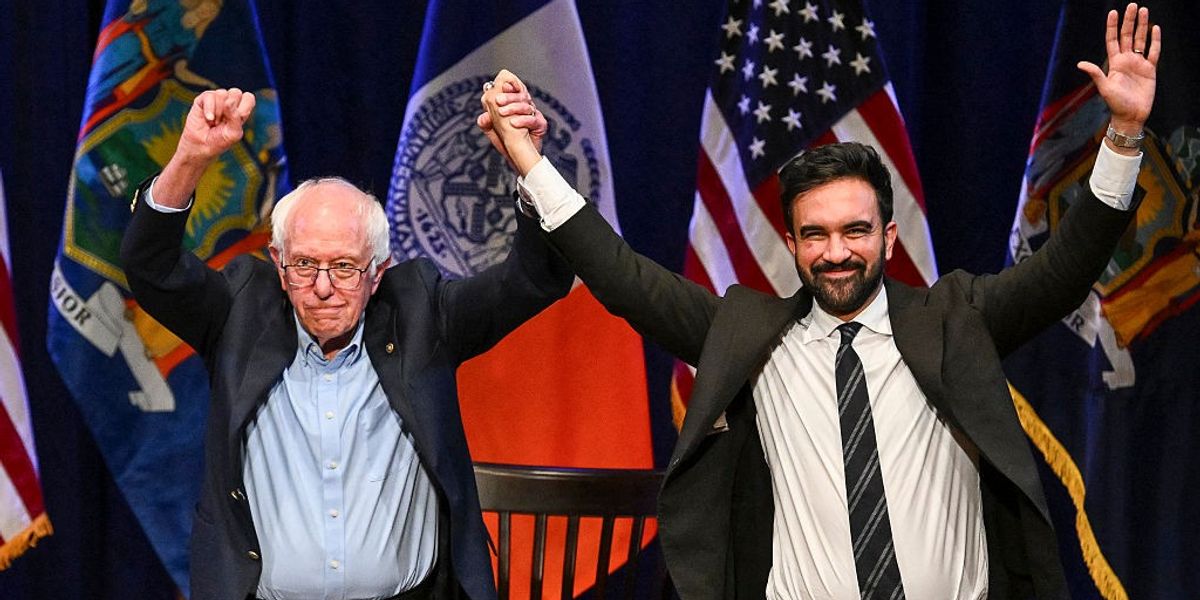
Mamdani’s victory is therefore not a “red threat” for the establushment, but part of a broader phenomenon of distrust and anger towards the political system – although the phenomenon remains within its two pillars, the Republicans and the Democrats. In a way, Trump was the one who “saved” the Republicans, capitalizing on mass discontent and turning the growing class anger in American society towards the far right. As for the Democratic Party, a counter-effort was expressed by Bernie Sanders, but he failed to break the vicious circle of social discontent being trapped within the framework of bourgeois polarization. The experience of the election of other popular members of the DSA (such as Alexandria Ocasio-Cortez) is that in the end they do not change the Democrats, but the party changes them. Cortez went so far as to vote – in the midst of genocide – in favor of military aid to Israel, saying that it separates defensive weapons from offensive ones!
Mamdani’s declared goal is also to revitalize the Democratic Party, which emerged strengthened by victories in the states of Virginia and New Jersey. There, his candidates belonged to the so-called group of “CIA Democrats”, leaders with previous experience in the secret services and the military network. The Democratic establishment generously gave its support to Mamdani and not to his internal rival Cuomo, through former President Obama, but also the governor of the state of New York, Kathy Hotchul, who belongs to the right wing of the party and has opposed tax increases for the wealthy.
Political polarization, however, is growing and will not be easy to integrate. 76% of respondents aged 18-35 responded that they see socialism positively and the “stigmatization” of Mamdani as a “communist” probably had the opposite effect. His solidarity with Palestine, despite its limits, not only did not isolate him but strengthened him, reflecting the radicalization tendencies especially among the youth. However, the refusal of any perspective to escape the framework of the Democratic Party slows down these trends, as in modern capitalism even small social conquests presuppose class and political independence from bourgeois politics.
Μαμντάνι: Ένας δήμαρχος εντός των ορίων συστήματος και Δημοκρατικών